All Categories
Featured

Ensuring Longevity Through Proactive Tree Support
Table of Contents
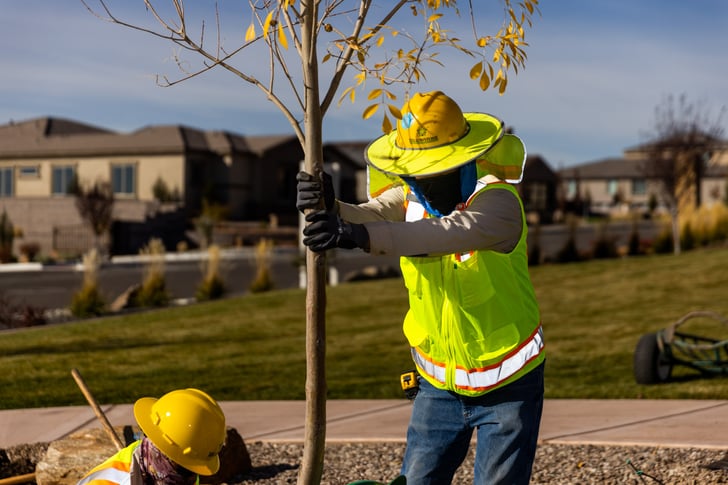
Never pile mulch up around trunk of tree. Leave a 10 inch radius from trunk of tree.
Rock areas shall consist of a landscape fabric. 1:11 Cornell Structural Soil Mix shall be used under all tough surfaces where trees are to be planted in tree wells surrounded by concrete, pavers, or asphalt.
Then type "Outreach > Structural Soil" in the Browse Box at the top. 1:12 Tree ball and burlap root ball diameter shall be 12" for every 1" of trunk size. 1:13 Need to there be an inconsistency in between the American Association of Nurserymen Standards and UNR Standards, UNR requirements shall dominate. 1:14 The specialist will alert owners representative to approve plant positioning before the planting of all trees, shrubs, & grass.
Comparing New or Traditional Irrigation Management
1:16 Trees that have actually been grown connected directly to stakes will not be accepted. 1:17 Trees and shrubs kept on website shall have their containers or root balls secured from direct sun light by specialist. For balled and burlap (B & B) trees, heel in and cover with mulch up to top of root ball.
1:18 Trees and shrubs stored on site will be watered frequently to keep consistent moisture, daily if essential. Change per climatic conditions. 1:19 Do not install plants when the ground is frozen. 1:20 Install plant product plumb and in the center of pit slightly above adjacent grade. 1:21 Do not prune any plant material without permission from owner's agent.
1:23 Container plants with largely swirling rigid roots inside the container surface area will not be accepted. 1:26 There shall be a pre-construction conference with owner's agent before construction starts.
Commercial Irrigation ServicesExceptions allowed only with approval of owner. Existing trees shall be maintained where Tree stacking approach to be evaluated with Owner. Specialist to submit landscape security and watering strategy, and schedule to Landscape style shall lessen water usage and Water conserving native plant materials will be used to the best extent Grading, dust control, weed control, curbs, seamless gutters, streets, off-street parking and walkways shall comply with regional regulations and local style and site building standards.
Protecting Property Aesthetics for the Future
(refer to ANSI 300 requirements) Thinning: The canopy of a tree periodically ends up being so dense that the canopy requires to be thinned. Thinning is the removal of lateral branches at their point of origin or the reducing of a branch or stem by cutting a lateral big sufficient to presume the terminal function.
Trees may need to be thinned to lessen storm damage of to enable better air flow to lower illness issues. Trees might be thinned as a bird control step to develop a less desirable roosting site. More commonly, trees are normally thinned to enable extra light to reach plants growing underneath the canopy.
There are numerous factors for raising the crown of a tree. Along streets and parking lots, it is crucial that the trees have the appropriate clearance of 14 ft. 6in. Pedestrian walkways will not go beyond 7 ft.
Deadwooding: Throughout the life of a tree, it is a normal process for procedure branches in the canopy to die while new branches are being created.
New Irrigation Design Installation for Large Landscapes
This is specifically crucial for deadwood larger than 4 inches, which might cause major injury to people and residential or commercial property. Elimination: Like all life on earth, trees eventually decrease and pass away. Studies have actually revealed that due to the several tensions that exist in the metropolitan environment, trees have a considerably reduced life expectancy.
There are two main factors for eliminating a tree: aesthetics and safety. When a tree decreases into bad condition, it has exceeded its useful life and ought to be removed so that it can be changed with an energetic healthy tree. In many cases, a tree, no matter visual appearance, positions a risk to people and home and must be removed.
These trees require to be pruned or formed to direct future growth. The outcome of this kind of pruning is a more lovely and structurally sound tree and a substantial decrease in future maintenance costs. Cabling/bracing: Cabling and bracing is the art and science of using cable televisions and/or wood screws (braces) to fix or lengthen the effectiveness of a tree.
Braces are usually utilized in combination with cable televisions to assist support of pull split trunks back together. Cabling and bracing must not be used to remedy harmful tree problems, however they can be useful in lengthening the life of a substantial tree. Cavity filling: Trees suffer mechanical damage from a number of sources consisting of landscape upkeep equipment, vehicles, the environment and other elements.
Smart Irrigation Systems for Commercial Resilience
Cavities can be concealed within the trunk, or they can be exposed to the surface area leaving a little or big open hole. It ends up being challenging or impossible for the tree to grow across the expanse and repair the damage, so it sometimes ends up being essential to fill the cavity so that callus can grow throughout the hole and shut off the cavity to the outside.
Stumps detract from the aesthetic appearance of the campus and can produce safety hazards. Stumps likewise affect other landscape upkeep activities by producing a barrier that needs to be trimmed around. Stumps are gotten rid of by using a maker to grind the stumps listed below the soil surface area. Fertilizing: Consistent removal of leaf particles around a tree eventually leads to a loss of important nutrients that would normally be available to a tree in a natural forest.
This generally includes injecting a soluble, slow-release fertilizer into the soil so that it can be used up by the root system. Mulching around the trees is likewise crucial for returning nutrients to the soil. Spraying: Occasionally, trees are attacked by different pests and microorganisms and need to be dealt with to safeguard them from illness.
How Smart Canopy Care Reduces Property Risk
Soil changing: Biostimulants and Mycorrhizal fungi are included into the soil profile near the root system of the tree to improve health and vigor. The University prioritizes water-conserving landscape style that needs very little upkeep. Due to the fact that the University campus is a designated arboretum, it includes a diversity of plants, including non-native types and drought-intolerant varieties.
The university arboretum contains edible plants such as fruit trees, berry bushes, and herbs as ornamentals, however they were not planted for usage as a food source, and brand-new edible plants are not being added to the landscaping. Poisonous plants are not used near water, dining establishments, and kids's centers.

Latest Posts
How Smart Canopy Care Reduces Property Liability

Custom Irrigation Management for Hospitals

Mitigating Landscape Risks On Commercial Grounds